Two Cities, One Season: Montreal vs. Toronto for Fall and Holiday Travel in 2026

Canada doesn't do a single holiday season — it does two, running in parallel, about five hours apart by train, and almost entirely different in character. Montreal turns Old World the moment the temperature drops: cobblestone, candlelight, mulled wine in the cold. Toronto turns cosmopolitan: glass towers lit gold, a Victorian-era district transformed into its own self-contained wonderland, a skyline that feels unmistakably North American even at its most festive.
Both are genuinely worth the trip. The honest answer to "which one" depends entirely on what kind of holiday feeling you're chasing. Here's the full picture — festivities, hotels, nightlife, and the tables worth booking — in both cities for 2026.
The Festivities: Old World Romance vs. Victorian Spectacle
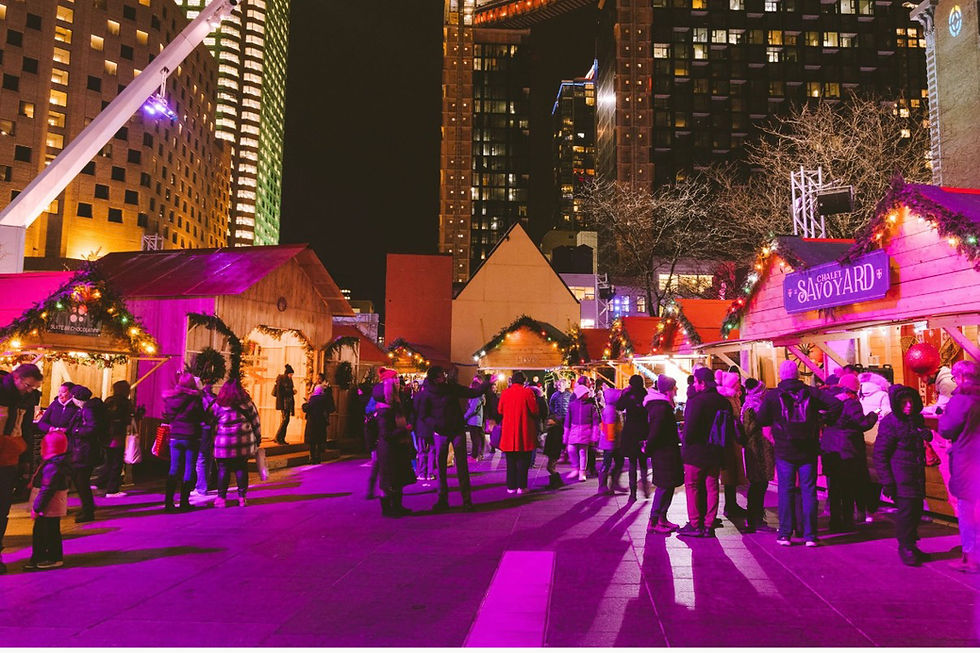
Montreal's holiday season centres on two markets that complement each other rather than compete. The Great Montreal Christmas Market runs from November 13, 2026 through January 3, 2027 in the Quartier des spectacles, with nearly 60 artisan chalets, free entertainment, and fire pits to warm up at between browsing stalls — and unlike most Christmas markets, it doesn't pack up on the 24th, staying open straight through Christmas Eve and Day. A few kilometres away, Montreal's Christmas Village takes over Atwater Market from November 26 to December 24, leaning harder into local artisan workshops and Quebec terroir gastronomy. New this year: a "Kingdom of the Elves" interactive storyline connecting both markets, built for families moving between the two. Come evening, there's always the Orangery lounge to thaw out in with a coffee, or a Montreal Canadiens game at the Bell Centre to round out the night.
Toronto counters with the Distillery Winter Village, returning for its 17th year on November 12 through January 3, 2027, taking over 13 acres of the Distillery District's cobblestone streets and Victorian-era warehouses. The 55-foot Christmas tree — strung with 80,000 lights — anchors a scene built for wandering: carollers working the crowds, outdoor holiday bars filling up after dark, and a new Nutcracker-themed experience at Soulpepper Theatre this year, styled after a vintage European department store. Beyond the Distillery, Toronto layers on the Cavalcade of Lights at Nathan Phillips Square, the Santa Claus Parade, and ice skating right downtown — a city that treats the whole urban core as the stage rather than concentrating everything in one market.
The distinction worth knowing: Montreal's markets feel European by instinct — French-Canadian, candlelit, built around food and wine. Toronto's feels more deliberately staged — one spectacular district, dressed to the nines, with the rest of downtown's holiday energy radiating outward from it.

The Hotels: Grand Dame vs. Glass Tower
Montreal's luxury hotel scene runs on history. The Ritz-Carlton Montréal has presided over Sherbrooke Street West since 1912 — a genuine living institution, where afternoon tea in the Garden restaurant and a room overlooking the hotel's famous duck pond remain two of the city's most timeless pleasures. Hotel Birks, inside the former Birks jewellery flagship, trades on the same old-money polish in a more intimate package. The Four Seasons Hotel Montreal rounds out the top tier with a full-service spa and some of the city's most reliably excellent service, while Hotel Nelligan and Hotel Place d'Armes anchor Old Montreal for anyone who wants cobblestone views over the duck pond.
Toronto's top hotels lean architectural rather than historical. The Four Seasons Hotel Toronto in Yorkville holds Two MICHELIN Keys and remains the undisputed address for the city's discerning set, with Café Boulud serving some of the best French cooking in the country right downstairs. The Ritz-Carlton Toronto, facing David Pecaut Square, holds a MICHELIN Key of its own and pairs a glass façade with an interior built around Canadian art. For something with more personality, the Bisha Hotel and 1 Hotel Toronto — both in the Entertainment District and King West — bring a design-forward, slightly younger energy, while the Omni King Edward Hotel offers the city's one genuine piece of old-world charm: built in 1903, with a guest list across the decades running from The Beatles to Margaret Thatcher.
The takeaway: Montreal's best hotels sell you history you can touch. Toronto's best hotels sell you architecture, Michelin-level polish, and a skyline view that Montreal, with its height restrictions protecting the view of Mont Royal, simply can't offer.

The Nightlife: Francophone Cool vs. Entertainment District Energy
Montreal's cold-weather nightlife rewards knowing where to go. The Plateau and Mile End stay busy with candlelit wine bars and francophone cocktail dens that feel miles from anywhere else in North America, while Old Montreal's cobblestone streets hide some of the city's best speakeasies behind unmarked doors. The city's bilingual culture gives its bar scene a genuinely different texture — part European sensibility, part North American hours.
Toronto's nightlife concentrates itself more obviously, radiating out from the Entertainment District and King West, where the Distillery District's own holiday bars extend the market's energy well past dark. Yorkville brings a more upscale, see-and-be-seen cocktail scene closer to the luxury hotel corridor, while King West's density of rooftop bars and lounges gives the city a bigger-night-out feel than Montreal typically offers on a given Tuesday.
The honest read: Montreal wins on atmosphere and discovery. Toronto wins on sheer scale and polish, particularly once the Entertainment District gets going on a weekend.

The Restaurants: Bistro Soul vs. International Ambition
Montreal's dining identity is unapologetically French-Canadian — bistros serving duck confit and tourtière alongside a genuinely serious natural wine scene, much of it concentrated in the Plateau and Old Montreal. The city's food culture treats a long, unhurried holiday dinner as a given rather than a special occasion.
Toronto plays a different game entirely, leaning on its sheer diversity — the city's food scene reads like a map of the world, with genuinely excellent Japanese, Italian, and global fine dining scattered from Yorkville to King West, Café Boulud at the Four Seasons standing as one easy anchor point for a serious holiday meal.
The Five Star Society Verdict
Choose Montreal if you want the holidays to feel like a European escape without the transatlantic flight — candlelight, bistro wine, a market that doesn't rush you out on Christmas Eve.
Choose Toronto if you want scale, architectural polish, and a single spectacular district built to be the entire holiday experience in itself.


Comments